
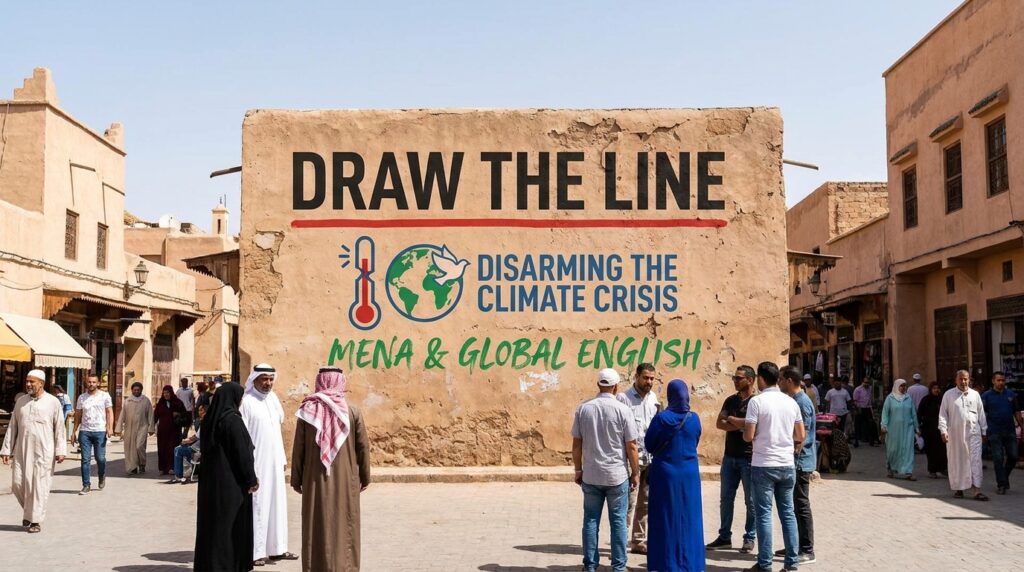
This article was prepared following on from a presentation given at the Climate Camp on ‘Disarming the Climate Crisis: the true cost of militarism’, hosted by IPPNW Germany. The climate camp runs in parallel to the formal Bonn Climate Conference, held 16-26 June. The speakers covered the impact of armed conflicts and militarization in the MENA region, the scale and impact of military GHG emissions and the impact of ever rising military spending on climate finance.
It is published as part of the Draw the Line global week of events Sept 15-22. Draw the Line…… against inequalities, tyranny, genocide, destruction, and chaos…for rights, jobs, justice, democracy, and a fulfilling life on a safe planet. https://drawtheline.world/
DISARMING THE CLIMATE CRISIS: THE TRUE COST OF MILITARISM
‘The climate crisis directly results from the capitalist system, held up by colonialism, imperialism, and corporate greed. The military, defending this system, cannot be trusted to reform the system it exists to preserve. Not only does the military exacerbate climate change, but it also works in opposition to potential green policies. The efforts made by lower, working and middle-class individuals to save the planet won’t matter if billionaires, corporations, and over-funded militaries continue to pollute it without being held accountable’.
Bethlehem Samson, Spheres of Influence
In this age of global boiling, the big economies are scaling ever-upward their military spending. Israel’s genocide of the Palestinian people, the ongoing war in Ukraine and Donald Trump demanding that NATO massively increase its spending have seen big military spending governments lead people and planet to an unforgiveable, incomprehensible reality: as we head over 2 degrees of heating, there are trillions of dollars for wars and arms company profits, but no money for climate finance and no regard for the attendant GHG emissions that will accrue from that military spending. Additionally, increasingly around the world, we are seeing government funding for international aid and public services shamefully being diverted to military budgets.
The Middle East and North Africa (MENA) region is one which has endured decades of high levels of armed conflict, militarization, and excessive military spending. It is also a region facing the full consequence of climate change.
And it is women and girls who pay the highest price of all in war and conflict.
PART ONE: MILITARIZATION & ARMED CONFLICTS IN THE MENA REGION
Many MENA countries have aspired to close gender equality gaps, recognizing that gender equality is essential for peace and stability. Societies with higher levels of gender equality tend to experience lower levels of violent conflict, and peace processes that involve more women tend to last longer.
But decades of high levels of armed conflict, militarization, and excessive military spending have undermined gender equality, reversed economic progress, and jeopardized peace efforts. Women and marginalized groups bear the heaviest burden of conflict, facing conflict-related sexual violence, displacement, loss of resources, poverty, and hunger
WOMEN & GIRLS ARE PAYING THE GREATEST PRICE
For example, before the outbreak of prolonged conflicts, the majority of Iraqi and Syrian women were literate. Today, as a result of ongoing violence, female illiteracy rates have risen significantly. Iraq, embroiled in conflict for decades, suffers from entrenched patriarchy that has eroded progressive family laws. Recently, Iraq has adopted a new law allowing girls to be married at the age of 12. Egypt, while not experiencing armed conflict, allocates a large portion of its budget to arms imports. It has among the lowest rates of women’s economic participation and one of the highest female illiteracy rates, both regionally and globally.
Conflict, instability, and insecurity leave women especially vulnerable to economic marginalization and expose them to higher risks of sexual and other forms of gender-based violence. Numerous armed groups perpetuate harmful, militarized masculinities throughout the region.
o Nearly half of MENA countries are classified as fragile and conflict-affected states.
o MENA also hosts the largest refugee population in the world.
o Lebanon, for example, has the highest per capita proportion of refugees globally, hosting one in eight of the world’s refugees.
o Jordan has long hosted large refugee populations, primarily from Palestine, Iraq, and Syria.
o Egypt hosts over a million registered refugees and asylum seekers, mostly from Sudan and Syria, while the IOM estimates about nine million international migrants live in Egypt, accounting for 8.7% of its population. (IOM Egypt)
Women living in conflict zones are exposed to higher levels of trauma, resulting in widespread post-traumatic stress disorder and depression. Palestinians are particularly at high risk due to prolonged exposure to violence and displacement.
Intersecting issues such as conflict and climate change place women and vulnerable populations at even greater risk. Conflict increases the likelihood of women and girls experiencing sexual and gender-based violence, widens educational gaps, hinders access to sexual and reproductive health services, and restricts women’s political and economic participation.
Over many decades external powers have significantly shaped the MENA region through militarized policies. This impact goes beyond physical and economic harm, deepening gender gaps in healthcare, employment, representation, and humanitarian aid. Peace-building efforts have historically overlooked women’s specific needs and potential contributions. Since October 2023 Israel has unleashed a brutal and calculated campaign of ethnic cleansing against Gaza, which has claimed tens of thousands of lives killed and injured, with women and children bearing the heaviest toll (over 70% of victims).
The genocide has reduced Gaza’s infrastructure to rubble, leaving millions of women and children without access to essential services including health care, education, water and sanitation, shelter. The deep psychological trauma will last for generations to come. The world has stood by, witnessing never-ending massacres, only made possible with extensive military and weapons support from the USA, UK and Europe. Palestinian women were, and still are, bearing the brunt of its unimaginable horrors: displacement, the loss of their children and their loved ones, and relentless exposure to sexual and gender-based violence.
MIDDLE EAST & NORTH AFRICA REGION: EXCESSIVE MILITARY SPENDING
Military expenditure has risen sharply due to escalating occupations and conflicts. In 2024military spending in MENA countries totalled $273 billion — 19% higher than in 2023 (according to SIPRI). MENA countries also have the highest military burden (military spending as a share of GDP) and the highest military spending relative to government spending of any region worldwide.
Adding to this, 90 million people in the MENA region are expected to face water stress by 2025. The region is warming faster than the global average, with heat and drought accelerating desertification — an alarming trend in a region already 82% desert. Existing social problems, such as gender inequality, exacerbate these environmental threats.
Heavy spending on militarization severely hinders social development, particularly in areas vital to women’s well-being and empowerment. Many governments allocate significant portions of their budgets to defense and security at the expense of essential services like health and education.
Militarization affects women in both private and public spheres. Privately, it reinforces patriarchal norms; publicly, high military expenditure crowds out civilian spending, increasing women’s burden in unpaid care work. It also widens income inequality, disproportionately affecting women and children due to gender gaps in wages, income, and asset ownership. Low female representation in legislative and executive bodies across the MENA region limits advocacy for reducing defense spending.
Militarization is likely to worsen gender inequality, as women rely heavily on social welfare programs. In militarized societies, gender equality is not a government priority. By reinforcing patriarchal structures, militarization limits economic opportunities for women, further suppressing female labor force participation.
Military spending ranks among the highest globally in MENA countries like Qatar, Saudi Arabia, and Egypt. Between 2020 and 2024, 29% of global arms imports went to the MENA region. (SIPRI) From 2017 to 2021, Qatar, Saudi Arabia and Egypt were among the world’s top arms importers, prioritizing military spending over climate adaptation and renewable energy investments. The USA dominates 52% of regional arms supply, followed by European countries such as France, Italy, and Germany.
A closer look at government budgets reveals that Egypt allocates a larger share to the military than to health or education. In Saudi Arabia, military spending rivals education spending and exceeds health expenditure. Israel, a major weapons producer, also imports arms, with the USA supplying about 70% of its total arms imports, and Germany contributing significantly as well.
MORE ARMS MEAN GREATER INSECURITY
Every increasing military spending does not bring greater security. It has the opposite effect. Between 2010 and 2022, conflicts almost doubled and 2023 saw the highest number of conflicts since WW2. Conflicts drive 80% of all humanitarian needs.
It is clear that the harmful impacts of militarized foreign policy must be addressed. Pervasive militarization has failed to bring stability; instead, it intensifies conflicts and generates new crises. Israel’s bombardment of Gaza reveals the horrendous the human cost of policies formed in a hyper-militarized state such as Israel.
Ultimately, both the MENA region specifically and the wider world more generally need urgent reform of the UN’s key peace and security decision-making body, the Security Council. Formed in the post-war world, it still reflects the post-colonial order 80 year later.
This is exemplified by the five permanent members−USA, China, Russia, France and the UK−remaining the largest arms exporters in the world. We urgently need a reformed Security Council that prioritizes funding for peace, not war, we need military spending to be reduced and redirected to climate action, a just transition for all and decent public services.
PART TWO: GLOBAL MILITARY EMISSIONS, MILITARY SPENDING & CLIMATE FINANCE
There is no secure nation or region on an insecure planet – the climate emergency is moving us over 2 degrees of heating above pre-industrial levels. At the very time that we need massive ambition on climate finance, domestic and international, the big military spending nations are instead prioritizing large-scale additional investments in conventional rearmament: heavily fossil-fuel-reliant fighter jets, tanks and warships.
GLOBAL SNAPSHOT
World military expenditure rose to over $2.7trillion in 2024, up by 37 per cent between 2015 and 2024. (SIPRI) The top 20 spenders alone account for more than 85% of the total global military spending. The 9.4 per cent increase in 2024 was the steepest year-on-year rise since at least 1988. For the second year in a row, military expenditure increased in all five of the world’s geographical regions, reflecting heightened geopolitical tensions across the globe.
If this trend continues, between 2025 and 2030 we can expect to see more than US$17 trillionspent on the global military, around 55% will be spent by Annex II rich developed countries on their own militaries. However, the trend is accelerating so the US$17 trillion will grow to be even higher as rich countries further increase their military expenditure
Russia’s military expenditure reached an estimated $149 billion in 2024, a 38 per cent increase from 2023 and double the level in 2015. This represented 7.1 per cent of Russia’s GDP and 19 per cent of all Russian government spending.
Ukraine was the eighth largest military spender in 2024, with spending increasing by 2.9 per cent to $64.7 billion—equivalent to 43 per cent of Russia’s spending. At 34 per cent of GDP, Ukraine had the largest military burden of any country in 2024. Ukraine received at least $60 billion in financial military aid in 2024, mainly from the USA as well as Germany and other European countries. If it were included, Ukraine’s military spending would have totalled $125 billion in 2024, which would have made it the fourth biggest spender in the world.
Israel‘s military expenditure surged by 65 per cent to $46.5 billion in 2024. Its military burden rose to 8.8 per cent of GDP, the second highest in the world. It was the 15th largest spender in the world before its war on Gaza. 80 percent of Israeli military production is exported and weapons make up 25 percent of Israel’s total industrial exports.
Iran’s military spending fell by 10 per cent in real terms to $7.9 billion in 2024. The impact of sanctions on Iran severely limited its capacity to increase spending. By comparison,Kuwait (one of the smallest countries in the word) spent $6bn p/a.
Saudi Arabia spent $80bn in 2024 and was the largest military spender in the Middle East in 2024 and the seventh largest worldwide.
NATO is now a 32-member security alliance. Since 2021, NATO nations have raised their combined defence budgets by 25 per cent to $1.5 trillion with many reaching the 2% GDP spending target. However, NATO’s newly announced 3.5% GDP spending goal would lead to a total military expenditure by 2030 of $13.4 trillion, a $2.6 trillion increase above current expenditure. (Tipping Point North South et al.)
China. If China decided to match NATO’s 3.5% GDP and adopt the same goal, it would double China’s military expenditure to $646bn, with the consequent impacts on military emissions and diversion of climate and social investments to military ends.
CLIMATE FINANCE
There are varied estimates for the sums needed to meet the climate finance needs of the global south and to be met by the global north. A UN Expert Panel in 2023 called for $2.4tr p/a by 2030; the civil society Climate Action Network International called for $5tr annually at COP29 in Baku. At that Baku meeting, parties agreed on $1.3tr p/a but with only $300bn coming from public finance. It was a huge betrayal of the Global South by the rich industrialised nations.
Yet, between 2013 and 2021, those richest countries spent $9.45 trillion on the military, 56% of total global military spending ($16.8 trillion) compared to an estimated $243.9 billion on additional international climate finance (TPNS et al.).
The “Value for Money” case is illustrated by the Lockheed Martin F-35 fighter jet programme. The $2 trillion estimated global total lifetime cost of its development (20 years) could have funded any one of the items below in the following way:
o UN disaster response for the next 400 years;
o UN disaster risk reduction for the next 4,000 years;
o Global biodiversity conservation at $100bn per annum for the next 20 years;
o WHO funding at $2bn per annum for the next 1,000 years;
o UN peacekeeping operations at current $4.5bn per annum for the next 444 years.
NATO’S NEW MILITARY SPENDING TARGET VS CLIMATE FINANCE
At the very time when NATO’s 32 members (including many of the world’s richest industrial nations) are failing to meet their climate finance obligations to the global south ― they are aiming to secure an extra $2.6tr military spending over the coming 5 years. (TPNS et al.)
o This sum would cover nearly three years worth of climate finance needs of developing countries at $1 trillion a year.
o Or it could pay outright for the world’s global electricity grid to be upgraded and made net zero compatible by 2030.
o NATO states already spend 52 times more on the military than on climate finance,
The money for climate finance is there and sits inside military budgets.
GLOBAL MILITARY EMISSIONS
There is a positive correlation between military spending and military emissions – the more you spend on gas guzzling, big ticket weaponry, the more GHG emissions you emit. (Nature Communications)
Far from the global military positioning itself as part of the climate change solution (such as humanitarian response) it is a major contributor to climate change, in peace-time and war
o The global military carbon footprint is estimated to be 5.5% of total global emissions.(SGR/CEOBS).
• This estimate does not include conflict-related emissions (Gaza, Ukraine, post 9/11 wars).
• This is more than the combined annual emissions of the 54 nations of the African continent.
• It is twice as much as emissions from civilian aviation.
o The GHG emissions burden of the Russian invasion of Ukraine is currently estimated to be 175 million tCO2e. (Initiative on GHG accounting of war et al.)
o Latest research on Israel’s war on Gaza estimates the emission burden of 31 million tCO2e. (Neimark et al.)
o Israel has dropped more bombs on Gaza in less than a year than were dropped on Dresden, Hamburg and London combined during WW2.
o NATO’s new 3.5% spending goal over the next 5 years if implemented would lead to an extra 2,330 million tonnes of carbon dioxide equivalent (MtCO2e) of total carbon emissions. (TPNS et al.)
• This is almost the same amount as the combined annual GHG emissions of Brazil and Japan.
THE ARMS INDUSTRY
Arms companies are the primary beneficiaries of public military spending, and much more so times of war and conflict. War, conflict, genocide are very much considered ‘good’ for the arms trade business.
The big winners of the current wave of militarisation are the top ten largest arms companieswhich are also based in NATO countries (USA, EU and UK). Their revenues rose by an average of 7.79% between 2023 and 2024. (SIPRI)
o The top 100 arms companies accounted for $600 billion in arms sales in 2021 (pre-Ukraine, pre-Gaza).
o The top 20 arms companies alone account for two thirds of the total arms sales in the world.
o They come from just a handful of countries: USA, China, Russia, UK, France and Italy.
And while arms profiteering soars, ever-increasing military spending does not deliver peace.
PART THREE: TRUE CLIMATE JUSTICE DEMANDS AN END TO (EVER RISING) MILITARISATION
“The same forces destroying our climate are bombing our people and stealing our future. We cannot separate climate justice from the struggle for freedom. From Gaza to the Amazon, we see how militarism and fossil capitalism fuel both ecocide and genocide. That’s why we are – to say: no more. No more war machines, no more climate colonialism, no more geoengineering experiments over our skies. The time to act is now. For justice, for life, for liberation.”
Mohammed Usrof, Executive Director Palestinian Institute for Climate Strategy
REDIRECTING THE GLOBAL MILITARY’S TRILLIONS
Military spending drives climate chaos. It sucks much needed funds from climate finance. It is a massive transfer of wealth by governments from tax payers to arms companies. And along the way, it not only reinforces centuries of western power over the global south, it is also in the process of turning the climate emergency facing hundreds of millions of people in the global south ― who have done NOTHING to cause climate chaos ― into a climate security issue for the global north.
Thus the time has come to include military spending as a legitimate source to tap for climate finance since clearly, the funds are there. It is vital we keep the ‘trillions for militaries but not climate finance’ in the spotlight.
As we approach COP30 we need:
o Brazil to show leadership by recognising the dangers posed by the escalation in military spending and put it on the COP30 agenda with the call for climate finance needs to be fully met instead of those of the big militaries.
o concrete plans for developed countries to reduce their military spending in order to invest in climate action in their Nationally Determined Contributions. We need Annex II states willing to divest from increasing military budgets and invest in climate change.
o military emissions to be fully addressed within the UNFCCC with full and transparent reporting of all military emissions in peace and war along with full and comprehensive plans for decarbonisation in line with net-zero. (TPNS)
But in truth, we need to go much further. Reform of the UN Security Council is vital. We must move away from out-dated 19th century and 20th framing of foreign and defence policy-making that has led to perpetual war throughout the 20th and 21st century.
As our human family faces 2 degrees of heating, there is no greater threat to our collective human safety than climate change. Those rich nations with the most responsibility for this must pay up and that includes usefully redirecting the military trillions into fully addressing the climate emergency.
Our survival depends on co-operation, not conflict.
Civil society must exert as much pressure as it can to drive home one message to our leaders:there is no secure nation on climate insecure planet.
Fatema Khafagy, Ph.D.
Co-Convener of the Arab States CSOs & Feminist Network
Focal Point of MENA WGC Coordinating Committee
Deborah Burton
Co-founder, Tipping Point North South/Transform Defence project
